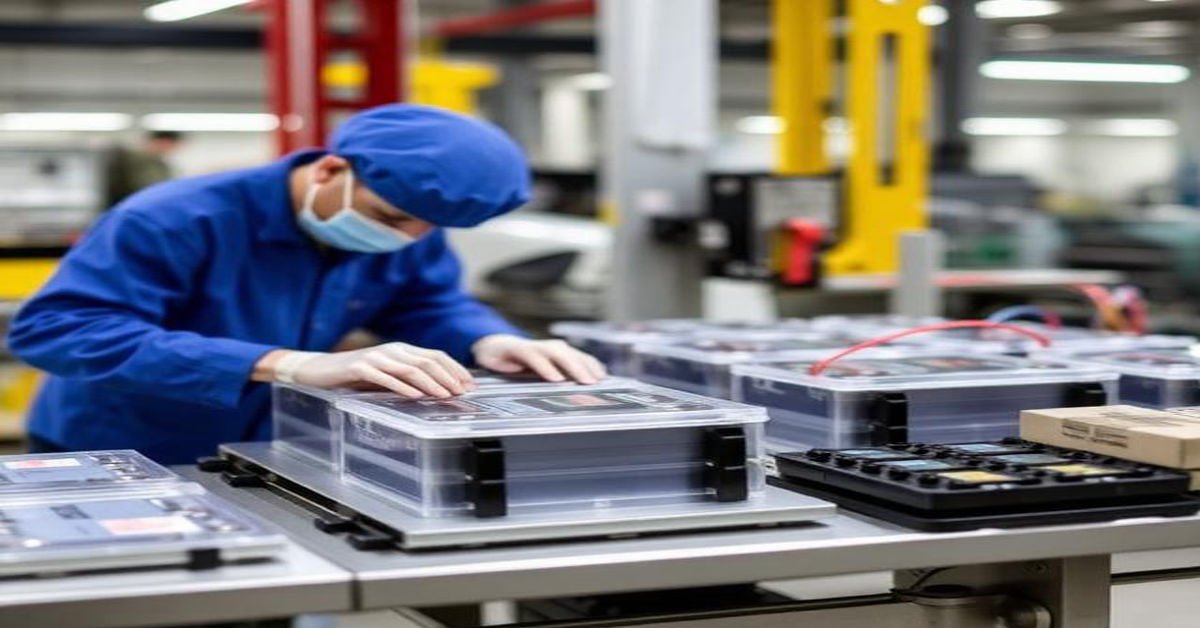
Electric vehicles are entering a decisive phase where battery innovation is becoming more important than ever. Among the most promising breakthroughs is the solid-state battery — a next-generation energy storage technology expected to redefine range, safety, charging speed, and longevity.
While headlines often focus on performance benefits, the real story lies in how these batteries are made. The EV solid-state battery manufacturing process is complex, precision-driven, and fundamentally different from traditional lithium-ion production.
This article explores the complete manufacturing journey, materials involved, engineering challenges, industrial readiness, and why automakers are racing to scale it.
What Is a Solid-State Battery?
A solid-state battery replaces the liquid electrolyte found in conventional lithium-ion cells with a solid electrolyte. This shift dramatically changes cell architecture and manufacturing steps.
Traditional batteries rely on:
-
Liquid electrolyte
-
Porous separators
-
Graphite anodes
Solid-state batteries use:
-
Ceramic, sulfide, or polymer solid electrolytes
-
Lithium metal anodes
-
Dense layered structures
This configuration allows higher energy density and improved thermal stability.
Why Manufacturing Matters More Than Chemistry
The challenge is not discovering the chemistry — it’s manufacturing at scale. Solid electrolytes are brittle, moisture-sensitive, and require ultra-clean environments.
Production must achieve:
-
Nanometer-level layer uniformity
-
Perfect interfacial contact
-
Defect-free stacking
-
High-pressure lamination
Even minor imperfections can cause dendrite formation or internal resistance failures.
Key Raw Materials Used
| Material | Purpose | Manufacturing Sensitivity |
|---|---|---|
| Lithium Metal | Anode | Extremely reactive |
| Solid Electrolyte (Ceramic/Sulfide/Polymer) | Ion transport | Moisture sensitive |
| Cathode Active Material | Energy storage | Requires precise coating |
| Conductive Additives | Electrical flow | Must be evenly dispersed |
| Protective Layers | Interface stability | Ultra-thin deposition |
Step-by-Step EV Solid-State Battery Manufacturing Process
1. Solid Electrolyte Synthesis
The process begins with manufacturing the solid electrolyte powder. Depending on chemistry:
-
Ceramic electrolytes require high-temperature sintering
-
Sulfide electrolytes require inert atmosphere milling
-
Polymer electrolytes are solution-cast
Purity and particle size directly affect ionic conductivity.
2. Cathode Composite Preparation
Cathode active materials are blended with:
-
Solid electrolyte particles
-
Conductive agents
This dry mixing process must ensure uniform distribution to avoid ion bottlenecks.
Unlike lithium-ion slurry coating, this stage often uses solvent-free methods.
3. Thin-Film Layer Formation
Manufacturers create ultra-thin layers via:
-
Tape casting
-
Cold pressing
-
Vapor deposition (in advanced setups)
Layer thickness control is critical for energy density and stability.
4. Lithium Metal Anode Handling
Lithium metal sheets are:
-
Rolled into micrometer thickness
-
Cut in dry rooms
-
Laminated directly onto electrolyte layers
Handling lithium safely is one of the biggest industrial hurdles.
5. Layer Stacking
Battery cells are built by stacking:
Cathode → Solid Electrolyte → Lithium Anode
This stacking requires high-precision robotics to prevent micro-gaps.
6. High-Pressure Compression
Cells undergo mechanical pressing to ensure full interfacial contact.
Poor pressure control leads to:
-
Increased resistance
-
Structural cracks
-
Capacity loss
7. Cell Packaging
Cells are sealed in:
-
Hermetic pouches
-
Rigid casings
Moisture protection is far more stringent than conventional batteries.
8. Formation Cycling
Cells are slowly charged and discharged under controlled conditions to stabilize interfaces.
Solid-state batteries need longer formation times compared to lithium-ion.
Manufacturing Differences vs Lithium-Ion
| Aspect | Lithium-Ion | Solid-State |
|---|---|---|
| Electrolyte | Liquid | Solid |
| Separator | Required | Not required |
| Anode | Graphite | Lithium metal |
| Safety | Flammable risk | Highly stable |
| Production Environment | Dry room | Ultra-dry + inert |
| Scalability | Mature | Emerging |
Major Manufacturing Challenges
Material Fragility
Ceramic electrolytes crack easily during handling.
Interface Resistance
Perfect layer bonding is difficult at large scale.
Moisture Sensitivity
Sulfide electrolytes degrade instantly with humidity.
Production Cost
Equipment is significantly more expensive.
Yield Rates
Defect rates remain high in pilot lines.
Technologies Enabling Scale
-
Roll-to-roll dry coating
-
Laser-assisted stacking
-
Cold sintering techniques
-
AI-driven defect detection
-
Advanced dry-room automation
Global Industry Progress
| Company | Manufacturing Stage | Focus Area |
|---|---|---|
| Toyota | Pilot Production | Ceramic solid electrolytes |
| QuantumScape | Pre-commercial | Lithium metal interface |
| Samsung SDI | Prototype | Thin-film stacking |
| Solid Power | Automotive trials | Sulfide electrolytes |
| CATL | Early development | Hybrid solid cells |
Impact on EV Performance
Solid-state manufacturing directly influences:
-
Vehicle range (30-50% increase potential)
-
Faster charging (10-15 minutes target)
-
Longer battery lifespan
-
Higher safety under extreme temperatures
Cost Outlook
Currently 4–8x more expensive than lithium-ion production. Costs expected to drop as:
-
Manufacturing yield improves
-
Equipment standardizes
-
Supply chains mature
Experts forecast commercial cost parity by 2030.
Future of Solid-State Gigafactories
Upcoming factories will require:
-
Fully automated dry environments
-
Precision lamination systems
-
Ceramic processing infrastructure
-
New quality inspection protocols
This will redefine how battery plants are designed worldwide.
Conclusion
The EV solid-state battery manufacturing process represents one of the most advanced engineering challenges in the energy and automotive sectors. It demands new materials, new equipment, new production logic, and entirely new safety standards.
1 thought on “EV Solid-State Battery Manufacturing Process”