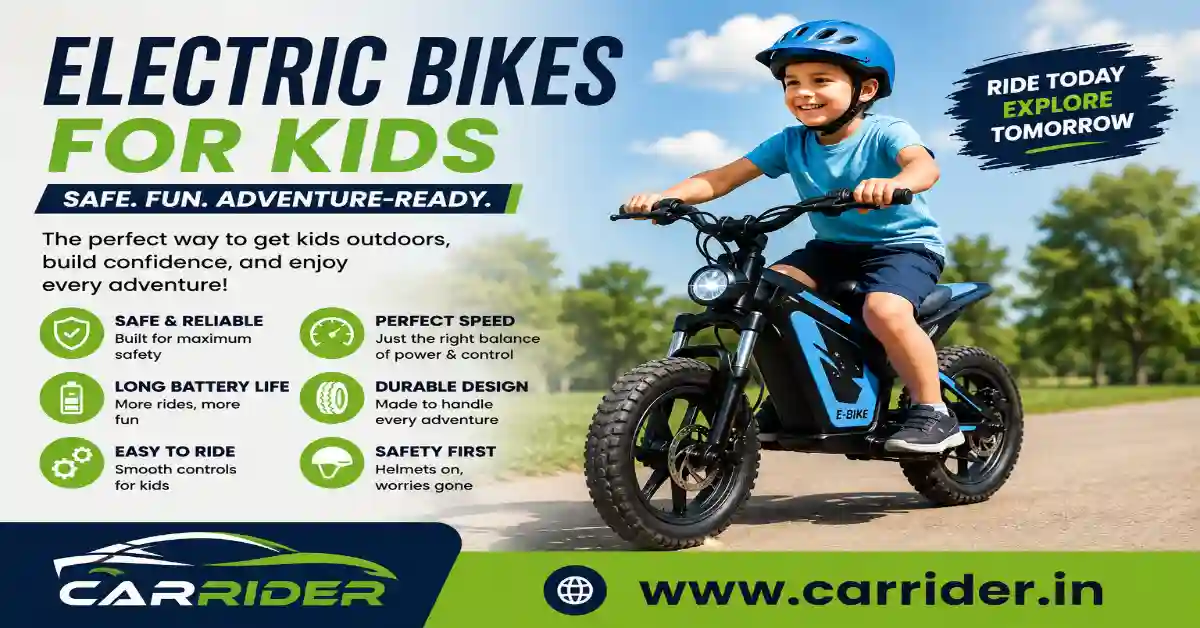
Electric Bikes for Kids for a child should not be treated like buying another toy. Parents need to think about the child’s size, riding ability, maturity, the bike’s speed, braking system, battery, weight, intended riding area, and local regulations. The right choice is not necessarily the bike with the biggest battery or the most powerful motor.
In fact, slower and simpler is usually a better starting point for a young or inexperienced rider.
Are Electric Bikes Suitable for Kids?
This is probably the first question parents should ask.
There isn’t one universal age at which every child becomes ready for an Electric Bikes for Kids. Children develop different levels of balance, judgment, coordination, and road awareness.
The American Academy of Pediatrics currently advises families to be especially cautious. Its 2026 guidance notes that e-bikes can be faster, heavier, and more difficult to control than ordinary bicycles. It also recommends considering age, maturity, riding skills, training, and local laws before allowing a child to ride one.
That distinction is important.
A child who can ride a traditional bicycle around the driveway does not automatically have the skills needed for an electric bicycle.
Electric Bikes for Kids.
The bike can accelerate faster than the child expects. It may also weigh considerably more than a conventional children’s bicycle. If something goes wrong, the rider needs to know how to stop rather than simply jumping off.
For younger children, a normal pedal bicycle may be the more appropriate choice.
For older children and teenagers who are genuinely ready, a carefully selected low-speed e-bike may make sense depending on local laws and the manufacturer’s age requirements.
What Makes a Good Electric Bike for Kids?
When shopping for an electric bike for a child, I would put speed near the bottom of the priority list.
Parents should instead look at these factors:
| Feature | What to Look For |
|---|---|
| Frame size | Appropriate for the child’s height and reach |
| Weight | Light enough for the child to control and move safely |
| Speed | A conservative speed appropriate for the rider |
| Brakes | Easy-to-reach and effective brakes |
| Tires | Suitable for the surface where the bike will be used |
| Controls | Simple controls that the child can understand |
| Battery | Reputable battery and charger system |
| Motor | Moderate assistance rather than excessive power |
| Lights | Useful front and rear visibility equipment |
| Safety equipment | Properly fitted helmet and appropriate protective gear |
| Manufacturer information | Clear age, weight and operating instructions |
One mistake parents sometimes make is choosing based on motor wattage alone.
A bigger number does not automatically mean a better children’s bike.
For a young rider, extra power can actually make the bike more difficult to control. A predictable power delivery system is much more useful than impressive specifications printed on a product page.
Size Matters More Than Parents Think
A bicycle can have excellent components and still be the wrong bike if the child cannot comfortably control it.
Before buying, check whether the child can reach the handlebars and brakes naturally. Their feet should be positioned appropriately when stopped, and they should be able to control the bicycle without stretching or leaning awkwardly.
The American Academy of Pediatrics recommends checking bike fit carefully and making sure the rider can operate the brakes properly.
This is one reason buying a bicycle purely from an online photograph can be risky.
A bike that looks small in a product photo may feel surprisingly large once it arrives.
If possible, have the child sit on the actual model before purchasing it.
Don’t Buy the Fastest Bike
This is probably the biggest buying mistake I would warn parents about.
A child doesn’t need an electric bike capable of reaching an impressive top speed.
The purpose should be controlled transportation or recreation—not racing.
The AAP’s current guidance notes that children aged 9 through 12 should not operate products travelling faster than 10 mph, and its recommendations for older children who are considered ready start with lower-class e-bikes rather than faster models. Families should also check their own local regulations because requirements vary by location.
That doesn’t mean every child should ride an e-bike at those exact limits. It means parents should take speed seriously and not assume that a child’s ability to ride a normal bicycle translates directly to a faster motorized bicycle.
If a bike has adjustable riding modes, start with the lowest practical setting.
Let the child learn control before increasing assistance.
Pedal Assist vs. Throttle
Electric bikes generally provide motor assistance in different ways.
Pedal assist provides motor power when the rider pedals.
Throttle control can activate the motor without the rider pedaling, depending on the bike.
For inexperienced riders, a throttle can create an unexpected acceleration problem.
Imagine a child is stopped at a driveway and accidentally twists the throttle while trying to reposition their hand. The bike may move before the child is ready.
That is why parents should understand exactly how the controls work before handing the bicycle over.
Don’t simply assemble the bike, charge the battery and send the child outside.
Spend time showing them:
- How the motor turns on and off
- How to start slowly
- How to brake
- How to stop the motor
- How to change assistance levels
- What the warning lights mean
- What to do if something feels wrong
- Electric Bikes for Kids
The First Ride Should Be Boring
That may sound strange, but it is good advice.
The first ride should not be an exciting trip down a busy road.
Find a controlled area away from traffic. A suitable private area or other legally permitted low-risk riding space can give the child an opportunity to learn the controls without dealing with cars, pedestrians and complicated intersections at the same time.
Start with braking.
Have the child ride slowly and stop at a predetermined point.
Then practice turning.
Electric Bikes for Kids.
Then stopping while turning.
Then starting again.
Only after the child consistently demonstrates control should you consider longer rides or more complicated environments.
This gradual approach is far more useful than simply telling a child to “be careful.”
Teach Braking Before Speed
One of the first exercises should be learning how much pressure is required to stop.
The child should understand that braking too suddenly can cause a loss of control, while failing to brake early enough can create a much more serious problem.
Practice several slow stops.
Then practice stopping when approaching an obstacle or marked line.
The goal isn’t to make the child nervous. It is to make the response automatic.
When something unexpected happens, there isn’t always time to think through every step.
Helmet Fit Is Non-Negotiable
A helmet should be part of the purchase decision, not an optional accessory added later.
The helmet should fit correctly and stay securely positioned on the child’s head. The AAP recommends bicycle helmets that meet the applicable CPSC bicycle helmet safety standard in the United States and provides specific fitting guidance, including keeping the helmet level and adjusting the chin strap properly.
Don’t buy a helmet several sizes too large simply because the child will “grow into it.”
A poorly fitting helmet is not a good bargain.
Also replace a helmet after a serious crash rather than assuming it can safely be reused.
Battery Safety Deserves Extra Attention
Electric Bikes for Kids is one of the biggest differences between an ordinary bicycle and an e-bike.
Parents should read the manufacturer’s charging instructions carefully and use the recommended charger.
The AAP advises families not to charge an e-bike battery while sleeping and recommends being present while charging. It also warns about battery fire and explosion risks.
The U.S. Consumer Product Safety Commission similarly recommends following manufacturer instructions and checking e-bike batteries and components for damage.
A simple household routine can help:
- Inspect the battery and charger.
- Look for visible damage.
- Use the manufacturer’s recommended charger.
- Charge in the location recommended by the manufacturer.
- Electric Bikes for Kids
- Keep charging away from children.
- Never ignore unusual heat, smoke, swelling or other signs of damage.
- Stop using a damaged battery and follow the manufacturer’s safety instructions.
Do not experiment with homemade battery modifications.
Check the Bike Before Every Ride
A two-minute inspection can catch obvious problems before they become bigger ones.
Teach your child to check:
Brakes: Do they work normally?
Tires: Are they properly inflated and free from obvious damage?
Handlebars: Are they secure?
Throttle and controls: Do they behave normally?
Chain or drivetrain: Is anything loose or damaged?
Lights and reflectors: Are they working and visible?
Battery: Is it properly secured?
The CPSC recommends checking components such as handlebars, brakes, throttle, bell, lights, tires, cables and frame before riding.
This inspection becomes especially important if the bicycle has been dropped.
Where Should a Child Ride?
Don’t assume that because an area is accessible to bicycles, an e-bike is automatically permitted there.
Rules can differ by country, state, city, road, trail or type of e-bike.
Some places have minimum age requirements, speed restrictions, helmet rules or restrictions on where particular classes of e-bikes can operate.
Before buying, check the rules that apply to your location.
This is especially important if you’re purchasing a Class 2 or Class 3 e-bike. The AAP notes that local regulations can differ and that some communities have stricter rules for faster e-bikes.
A Simple Test to Decide Whether Your Child Is Ready
Instead of asking only, “How old is my child?”, ask these questions:
- Can my child ride a normal bicycle confidently?
- Can they stop quickly and under control?
- Can they make controlled turns?
- Do they understand traffic signs?
- Do they follow instructions consistently?
- Can they judge when a situation is becoming unsafe?
- Can they resist racing friends?
- Will they wear a helmet every time?
- Can they remember basic maintenance checks?
- Can they control the bicycle without panic?
If several answers are “no,” buying an electric bike may be premature.
Age is only one part of readiness.
Common Mistakes Parents Should Avoid
Buying Based on Looks
A flashy design can be attractive, but appearance tells you almost nothing about whether the bike fits your child.
Choosing Too Much Power
More power can mean more difficulty controlling acceleration.
Ignoring Weight
An e-bike that is difficult for a child to push, balance or recover from a lean can become a problem when the battery is depleted.
Skipping the Test Ride
If possible, have the child try the bike before purchasing.
Treating It Like a Toy
An e-bike isn’t something a child should learn to operate casually.
Letting Friends Ride It
A bicycle adjusted for one child may not be appropriate for another rider. Weight limits and manufacturer instructions matter.
Removing Speed Restrictions
Do not modify the bike to make it faster.
The AAP specifically warns that removing or unlocking speed limiters increases risk and may violate applicable laws.
What About Cheap Electric Bikes for Kids?
Price is obviously important, but an unusually cheap Electric Bikes for Kids deserves extra scrutiny.
Don’t compare only the purchase price.
Look at the manufacturer’s reputation, warranty, replacement battery availability, braking equipment, charger, age and weight limits, assembly instructions and after-sales support.
A Practical Buying Checklist
Before pressing the “buy” button, go through this list:
Child
- Appropriate size?
- Comfortable on a normal bicycle?
- Good balance?
- Understands basic road safety?
- Mature enough to follow rules?
Bike
- Suitable speed?
- Suitable weight?
- Effective brakes?
- Appropriate frame size?
- Clear manufacturer instructions?
- Appropriate age and weight limits?
Battery
- Reputable manufacturer?
- Correct charger included?
- Clear charging instructions?
- Electric Bikes for Kids
- No signs of damage?
- Replacement battery available?
Safety
- Properly fitted helmet?
- Lights or reflectors?
- Safe riding location?
- Adult supervision where appropriate?
- Local e-bike rules checked?
If several boxes remain unchecked, don’t rush the purchase.
Final Thoughts
Electric Bikes for Kids for a child isn’t necessarily the one with the longest range, biggest motor or highest advertised speed.
It is the one the child can control confidently and safely.
Parents should treat an e-bike as a real vehicle rather than simply an expensive bicycle. That means choosing the right size, keeping speed reasonable, teaching braking and control, using appropriate safety equipment, maintaining the bike and checking local regulations.
