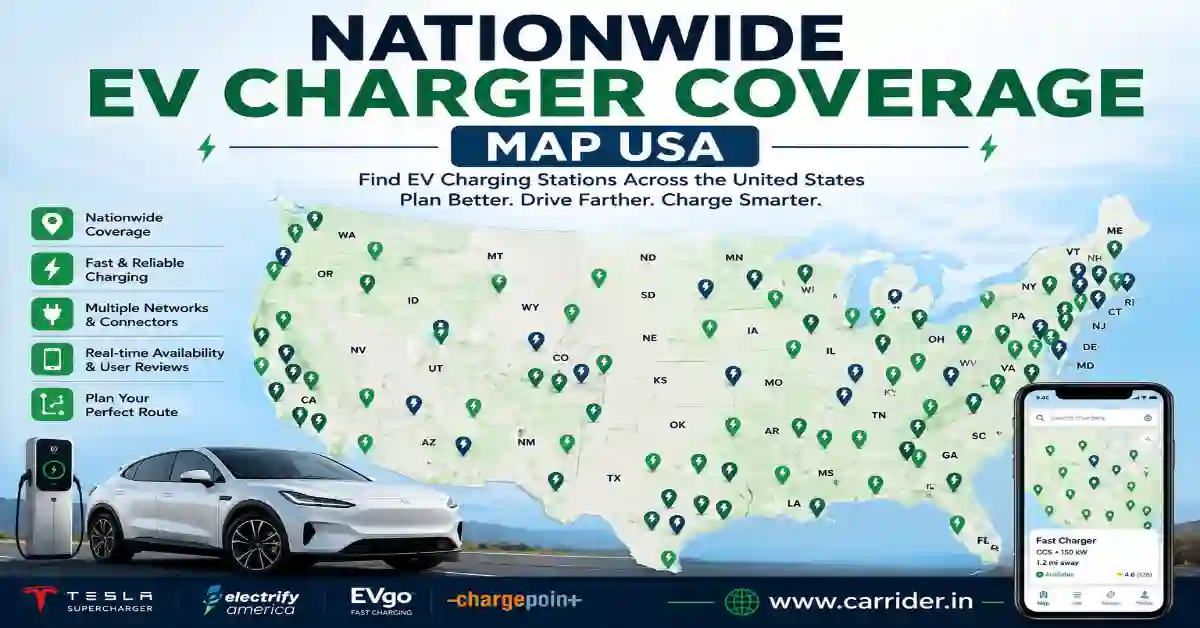
Nationwide EV Charger Coverage Map USA the idea of driving an electric vehicle across multiple states sounded stressful. My biggest fear wasn’t running out of battery—it was not knowing where the next charger would be. I still remember planning a long drive from Texas to Colorado. I spent hours switching between different charging apps, zooming in on maps, and trying to figure out whether a charging station was actually working. Some locations looked available online but had broken chargers when I arrived.
Today, nationwide EV charger coverage maps make road-trip planning much easier. Whether you drive a Tesla, Ford Mustang Mach-E, Rivian, Hyundai Ioniq 5, Chevrolet Equinox EV, or another electric vehicle, there are now thousands of charging stations spread across the United States. If you’re new to EV travel or want a better way to find chargers, this guide explains how nationwide EV charging maps work, which tools are worth using, and what I’ve learned from real-world driving.
Why EV Charger Coverage Matters
When people switch from gasoline vehicles to EVs, one concern comes up repeatedly:
“Can I find a charger when I need one?”
In daily city driving, this usually isn’t a problem. Most EV owners charge at home overnight.
The challenge appears during:
- Long-distance road trips
- Rural travel
- National park visits
- Business travel across multiple states
- Holiday traffic periods
A nationwide EV charger coverage map helps answer three important questions:
- Where are chargers located?
- What charging speed is available?
- Is the charger compatible with my vehicle?
Without this information, planning an EV trip becomes guesswork.
What Is a Nationwide EV Charger Coverage Map?
An EV charger coverage map is an interactive map showing charging stations across the United States.
Most maps display:
- Charger locations
- Charging network providers
- Connector types
- Charging speeds
- Real-time availability
- User reviews
- Route planning features
Instead of manually searching town by town, drivers can view charging infrastructure across entire states or the whole country.
Think of it as Google Maps for EV charging.
Major EV Charging Networks in the USA
Several charging networks contribute to nationwide coverage.
Tesla Supercharger Network
Tesla’s charging network remains one of the most reliable options in the country.
What I like most is consistency.
Most Supercharger locations have multiple charging stalls, clear signage, and dependable uptime.
Recent expansion has also allowed many non-Tesla vehicles to access selected Supercharger locations through adapters and compatible charging systems.
Benefits:
- Fast charging
- Wide interstate coverage
- Easy payment process
- Reliable station performance
Electrify America
Electrify America is one of the largest fast-charging networks for non-Tesla EVs.
I’ve used Electrify America during several interstate trips, and the charging speeds can be impressive when stations are functioning properly.
Common features:
- DC fast charging
- Highway corridor locations
- Mobile app support
- Multiple connector options
EVgo
EVgo has strong coverage in metropolitan areas and major travel routes.
It’s particularly useful for drivers who:
- Live in apartments
- Lack home charging
- Need quick urban charging stops
ChargePoint
ChargePoint operates one of the largest charging networks in North America.
The network includes:
- Workplace charging
- Shopping center chargers
- Public parking chargers
- Fast charging locations
One advantage is the large number of charging points available nationwide.
Best Apps for Viewing Nationwide EV Charger Coverage
After trying several options, these are the tools I rely on most.
1. PlugShare
PlugShare is often the first app I check.
Why?
Because real drivers leave reviews.
You can quickly see:
- Whether chargers work
- Waiting times
- Charging speeds achieved
- Recent user experiences
This helps avoid surprises.
2. A Better Routeplanner (ABRP)
For road trips, ABRP is incredibly useful.
It calculates:
- Charging stops
- Battery usage
- Elevation impact
- Weather considerations
I once used ABRP for a 900-mile trip and found its charging recommendations surprisingly accurate.
3. Google Maps
Google Maps has become much better for EV owners.
Many charging stations now include:
- Reviews
- Availability data
- Connector information
- Navigation support
For quick searches, it works well.
4. Tesla Navigation
Tesla owners benefit from built-in route planning.
The system automatically:
- Identifies charging stops
- Prepares battery temperature
- Estimates arrival charge level
- Updates based on traffic
This removes much of the planning effort.
Regions With Strong EV Charging Coverage
Charging infrastructure continues expanding nationwide, but some regions are better covered than others.
West Coast
States with excellent charger density include:
- California
- Oregon
- Washington
Drivers can often find multiple charging options along major highways.
Northeast
The Northeast has dense charging coverage because cities are relatively close together.
Popular EV-friendly states include:
- New York
- Massachusetts
- New Jersey
- Connecticut
Texas
Texas surprised me.
Many people assume EV charging is limited there, but interstate corridors now offer strong fast-charging coverage.
Cities such as:
- Dallas
- Houston
- Austin
- San Antonio
have extensive charging options.
Midwest
Coverage continues improving across the Midwest.
Major highways generally offer dependable charging, though rural areas may still require additional planning.
How I Plan an EV Road Trip
Over time, I’ve developed a simple routine.
Step 1: Check Battery Range
I start by looking at realistic range rather than the manufacturer’s estimate.
Factors affecting range include:
- Speed
- Weather
- Elevation
- Cargo weight
- Air conditioning use
Step 2: Open a Charger Coverage Map
I usually compare:
- PlugShare
- ABRP
- Network-specific apps
This helps confirm charger availability.
Step 3: Add Backup Charging Stops
One lesson I learned the hard way:
Never rely on a single charger.
Always identify at least one backup station nearby.
If a charger is occupied or offline, you won’t be stranded.
Step 4: Read Recent Reviews
A station may look perfect on the map.
Then you read reviews from yesterday and discover several chargers were out of service.
Recent user feedback is incredibly valuable.
Step 5: Charge Earlier Than Necessary
Many new EV drivers wait until battery levels get very low.
I prefer charging when the battery reaches around 20–30%.
This creates flexibility if plans change unexpectedly.
Common EV Charging Mistakes to Avoid
Ignoring Weather Effects
Cold temperatures can significantly reduce range.
Winter trips often require more frequent charging stops.
Not Checking Charger Speed
Not all chargers are equal.
A Level 2 charger may take several hours.
A DC fast charger may recharge most EVs much faster.
Always verify charging speed before arriving.
Depending on One App
Different apps sometimes display different information.
Cross-checking can save time and frustration.
Arriving With Extremely Low Battery
Many drivers try to maximize every mile.
This increases stress and reduces flexibility.
Leave yourself a comfortable buffer.
Nationwide EV Charger Coverage Map USA.
The Future of EV Charging Coverage in America
The EV charging landscape is changing rapidly.
Federal and state investments continue funding new charging infrastructure.
Major automakers are also adopting charging standards that improve compatibility across networks.
As more stations come online, nationwide coverage gaps are shrinking.
For most interstate travel today, finding a charger is significantly easier than it was even three or four years ago.
Final Thoughts
If you’re considering an electric vehicle or planning your first long-distance EV journey, don’t let charging concerns stop you.
Nationwide EV Charger Coverage Map USA. The biggest change I’ve noticed isn’t just the number of chargers—it’s the quality of the tools available to find them. A good nationwide EV charger coverage map can remove much of the uncertainty from EV travel.
My recommendation is simple: install PlugShare, learn how to use a route-planning tool like ABRP, and always have a backup charging option. After a few trips, checking charger locations becomes as routine as looking for gas stations used to be.
Once you get comfortable with the process, road-tripping in an EV feels surprisingly normal—and often more enjoyable than many people expect.

One thought on “Nationwide EV Charger Coverage Map USA”