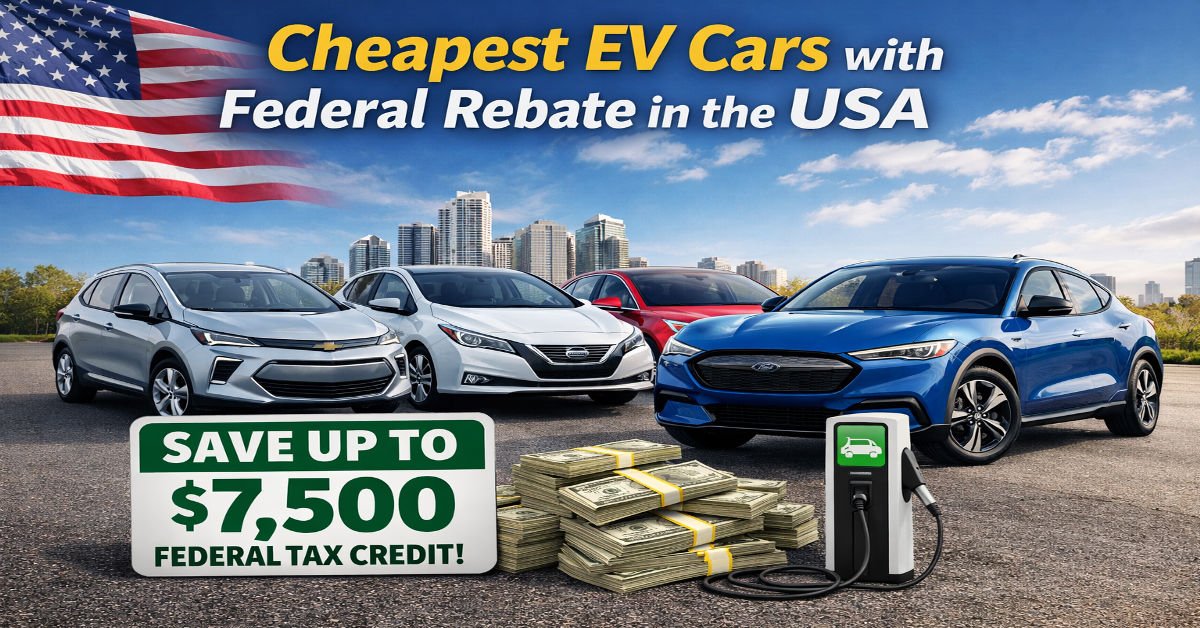
Cheapest EV Cars With Federal Rebate in the USA longer a luxury limited to high-income buyers. In the United States, falling battery costs, increased competition among automakers, and generous government incentives have made electric cars more affordable than ever. For budget-conscious families, students, and first-time EV buyers, the combination of low sticker prices and federal EV tax credits can significantly reduce the final cost of ownership.
This article provides a detailed, experience-based guide to the cheapest EV cars available in the USA that qualify for the federal rebate. It explains how the federal tax credit works, which models are currently the most affordable after incentives, and what buyers should realistically expect when choosing a low-cost electric car. The goal is to help readers make an informed, financially sound decision without confusion or misleading claims.
Understanding the Federal EV Rebate in the USA
The federal EV incentive, officially known as the Clean Vehicle Tax Credit, was redesigned under the Inflation Reduction Act. This program allows eligible buyers to receive up to $7,500 in tax credits for qualifying electric vehicles. However, not every EV qualifies, and not every buyer is eligible.
The rebate amount depends on several factors, including where the vehicle is assembled, where its battery materials come from, and the buyer’s income level. In many cases, buyers may qualify for a partial credit of $3,750 instead of the full amount.
Importantly, starting in recent years, the rebate can be applied at the point of sale through participating dealers, reducing the upfront purchase price rather than waiting until tax filing season.
Key Buyer Eligibility Rules
To claim the federal EV rebate, buyers must meet specific income and usage requirements. The vehicle must also be purchased for personal use and primarily driven in the United States.
Here is a simplified overview of buyer eligibility:
| Criteria | Requirement |
|---|---|
| Filing Status | Individual or joint taxpayer |
| Income Limit (Single) | Up to $150,000 |
| Income Limit (Married Filing Jointly) | Up to $300,000 |
| Vehicle Usage | Personal, not resale |
| Purchase Type | New vehicle only |
These rules ensure that the incentive supports middle-income households rather than luxury purchases.
Vehicle Eligibility Rules Explained Simply
Even if a buyer qualifies, the vehicle itself must meet strict requirements. These rules change occasionally, so buyers should always verify eligibility at the time of purchase.
Key vehicle requirements include:
-
Final assembly in North America
-
Battery components sourced from approved regions
-
MSRP price cap ($55,000 for cars)
-
Manufacturer participation in the IRS program
Because of these restrictions, some low-cost EVs may not qualify, while others qualify for only half of the credit.
Why “Cheapest After Rebate” Matters More Than Sticker Price
Many shoppers focus only on the advertised price of an EV. However, the true affordability comes from the final cost after applying federal incentives. An EV priced at $32,000 that qualifies for a $7,500 rebate can effectively cost less than a $26,000 model that does not qualify.
Additionally, EVs offer long-term savings through:
-
Lower fuel costs
-
Reduced maintenance expenses
-
Fewer mechanical failures
-
State and utility incentives (in some regions)
For budget buyers, these combined savings often make EVs cheaper than gas cars over time.
Cheapest EV Cars With Federal Rebate in the USA
Below are some of the most affordable electric cars in the US market that qualify for the federal EV rebate, based on current availability and eligibility rules.
Chevrolet Bolt EV
The Chevrolet Bolt EV has become one of the most popular budget electric cars in the US. It offers a practical range, compact size, and strong eligibility for incentives.
| Feature | Details |
|---|---|
| Starting MSRP | Around $26,500 |
| Federal Rebate | Up to $7,500 |
| Estimated Range | About 259 miles |
| Assembly Location | USA |
After applying the federal rebate, the effective price can drop significantly, making the Bolt EV one of the cheapest electric cars available for American buyers.
From real-world experience, the Bolt EV suits city commuters and small families who prioritize affordability and reliability over luxury features.
Chevrolet Bolt EUV
The Bolt EUV is a slightly larger and more spacious version of the Bolt EV. It offers more legroom and added safety features while remaining budget-friendly.
| Feature | Details |
|---|---|
| Starting MSRP | Around $27,800 |
| Federal Rebate | Up to $7,500 |
| Estimated Range | About 247 miles |
| Interior Space | More rear legroom |
The Bolt EUV is a strong option for families who want extra comfort without moving into higher price brackets.
Tesla Model 3 (Rear-Wheel Drive)
Tesla’s Model 3 is often associated with premium pricing, but the base rear-wheel-drive variant can qualify for federal incentives depending on battery sourcing.
| Feature | Details |
|---|---|
| Starting MSRP | Around $38,990 |
| Federal Rebate | Partial or full (varies) |
| Estimated Range | About 272 miles |
| Charging Network | Tesla Supercharger access |
While not the cheapest upfront, the Model 3 benefits from strong resale value, software updates, and a proven charging network. After incentives, it becomes more accessible for budget-focused buyers seeking advanced technology.
Nissan Leaf
The Nissan Leaf remains one of the longest-running electric cars in the US market. It is well-suited for urban driving and short commutes.
| Feature | Details |
|---|---|
| Starting MSRP | Around $28,000 |
| Federal Rebate | Partial eligibility |
| Estimated Range | 149–212 miles (variant dependent) |
| Ideal Use | City driving |
The Leaf is best for buyers who do not require long highway trips and want a simple, easy-to-own EV experience.
Ford Mustang Mach-E (Select Trim)
While not traditionally “cheap,” the base Mach-E Select trim becomes competitive after applying the federal rebate.
| Feature | Details |
|---|---|
| Starting MSRP | Around $42,000 |
| Federal Rebate | Up to $7,500 |
| Estimated Range | Around 250 miles |
| Body Style | Electric crossover |
This model appeals to buyers who want space, safety, and brand trust while still benefiting from government incentives.
Comparing Cheapest EVs After Federal Rebate
When rebate amounts are applied, the ranking of affordability changes significantly.
| EV Model | Approx. Price After Rebate |
|---|---|
| Chevrolet Bolt EV | ~$19,000 |
| Chevrolet Bolt EUV | ~$20,000 |
| Nissan Leaf | ~$22,000–$24,000 |
| Tesla Model 3 (RWD) | ~$31,000–$35,000 |
| Ford Mach-E Select | ~$34,000 |
These prices are estimates and may vary by dealer, location, and eligibility status.
Ownership Costs: EV vs Gas Cars
One overlooked advantage of budget EVs is lower total cost of ownership. Even the cheapest gas cars often cost more to maintain over time.
Typical EV savings include:
-
No oil changes
-
Fewer moving parts
-
Regenerative braking (longer brake life)
-
Lower electricity cost compared to gasoline
Over five years, many owners report saving thousands of dollars compared to gas vehicles in the same price range.
Charging Considerations for Budget EV Buyers
Affordable EVs generally support home charging using Level 1 or Level 2 chargers. Public charging networks are expanding rapidly, but home charging remains the most cost-effective option.
Charging cost estimates:
| Charging Type | Cost Per Full Charge |
|---|---|
| Home Level 1 | $6–$10 |
| Home Level 2 | $8–$12 |
| Public Fast Charging | $15–$25 |
Most budget EV owners charge at home overnight, minimizing costs and inconvenience.
Real-World Experience With Affordable EVs
From everyday users, common feedback includes:
-
Smooth and quiet driving experience
-
Immediate acceleration in city traffic
-
Reduced monthly expenses
-
High satisfaction for short and medium commutes
However, buyers should be realistic about limitations such as slower fast-charging speeds in some budget models and fewer luxury features.
Are Cheap EVs Reliable?
Modern electric vehicles, even at lower prices, have proven reliable due to simpler mechanical systems. Major manufacturers now offer solid warranties, especially for batteries.
Typical EV warranties include:
-
Battery warranty: 8 years or 100,000 miles
-
Powertrain warranty: 5–8 years
This long-term coverage increases buyer confidence, especially for first-time EV owners.
Tips to Maximize Savings When Buying an EV
To get the lowest possible price:
-
Confirm federal rebate eligibility before purchase
-
Check state and local incentives
-
Compare dealer point-of-sale credit options
-
Consider end-of-year or inventory clearance deals
-
Evaluate insurance costs in advance
Smart planning can reduce the final price far below the listed MSRP.
Final Thoughts: Is Buying the Cheapest EV With a Federal Rebate Worth It?
For many American households, the answer is yes. When federal incentives are applied correctly, some electric vehicles become cheaper than comparable gas cars. The Chevrolet Bolt EV, Bolt EUV, and Nissan Leaf stand out as some of the most budget-friendly options currently available.
The key is understanding eligibility rules, choosing a vehicle that fits daily driving needs, and focusing on long-term ownership costs rather than just the sticker price. With proper research, buying an affordable EV in the USA is no longer a future plan—it is a practical option today.
1 thought on “Cheapest EV Cars With Federal Rebate in the USA”