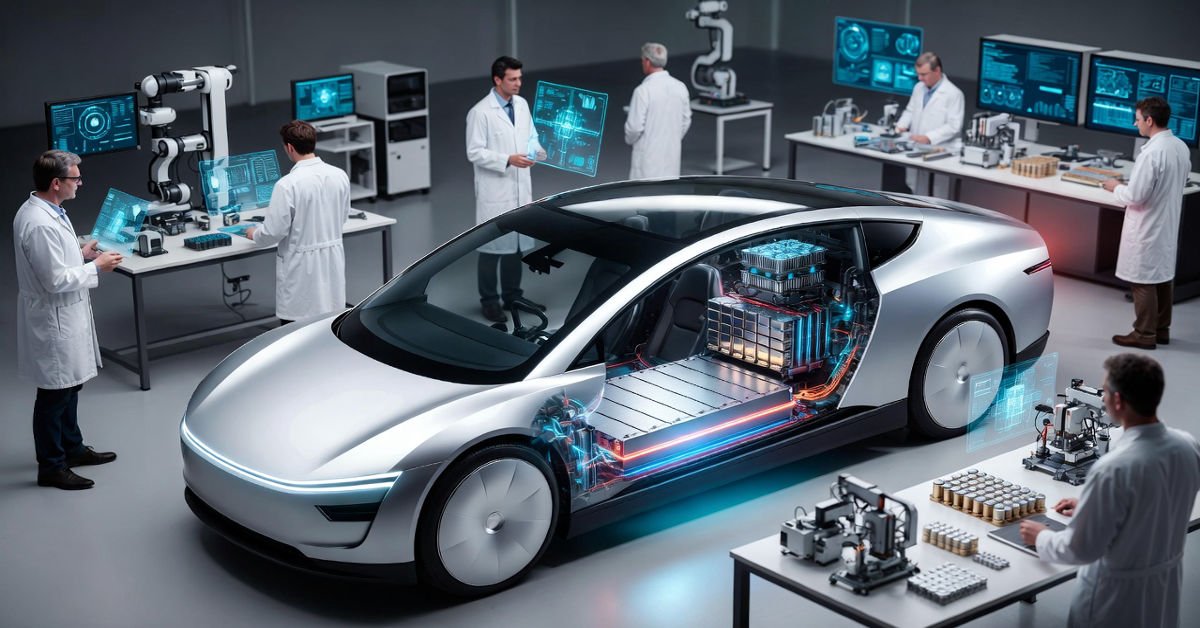
The global electric vehicle (EV) market is growing at an unprecedented pace, driven by climate goals, fuel cost volatility, and advances in battery technology. While lithium-ion batteries have powered this revolution for over a decade, researchers and automakers agree that the next major leap will come from electric vehicle solid-state battery research. This emerging technology promises higher energy density, faster charging, improved safety, and longer battery life compared to conventional lithium-ion cells.
Solid-state batteries replace the liquid electrolyte found in traditional batteries with a solid electrolyte, fundamentally changing how energy is stored and transferred. Major automotive manufacturers, research universities, and government laboratories are investing billions into this field. As a result, solid-state battery research is becoming one of the most critical areas in clean energy innovation.
This article explores the science behind solid-state batteries, current research trends, leading global players, technical challenges, real-world applications, and how this technology could reshape the EV industry.
Understanding Solid-State Batteries
A solid-state battery is an energy storage device that uses a solid electrolyte instead of a liquid or gel-based electrolyte. Traditional lithium-ion batteries rely on flammable liquid electrolytes to move lithium ions between the anode and cathode. Solid-state batteries use materials such as ceramics, sulfides, or polymers to perform the same function more safely and efficiently.
The basic structure includes:
-
A solid electrolyte
-
A lithium metal or silicon-based anode
-
A high-capacity cathode
-
Advanced interfaces to allow smooth ion transport
This design reduces fire risk, increases voltage stability, and allows the use of lithium metal anodes, which significantly boost energy density.
Why Electric Vehicle Solid-State Battery Research Matters
Electric vehicle adoption depends heavily on battery performance. Consumers want:
-
Longer driving range
-
Faster charging times
-
Lower fire risk
-
Longer battery lifespan
-
Reduced environmental impact
Solid-state battery research directly addresses these demands. By enabling higher energy storage in a smaller and safer package, EV manufacturers can design lighter vehicles with extended range and lower production costs over time.
Key Advantages of Solid-State Batteries
| Feature | Lithium-Ion Batteries | Solid-State Batteries |
|---|---|---|
| Electrolyte Type | Liquid or gel | Solid ceramic/polymer |
| Safety Risk | Fire and leakage possible | Very low fire risk |
| Energy Density | 250–300 Wh/kg | 400–500 Wh/kg (potential) |
| Charging Time | 30–60 minutes | 10–15 minutes (goal) |
| Battery Lifespan | 1,000–2,000 cycles | 3,000+ cycles (projected) |
| Operating Temperature | Moderate | Wider temperature range |
These advantages make solid-state technology ideal for long-range EVs, commercial fleets, and future autonomous vehicles.
Scientific Foundations of Solid-State Battery Research
Electric vehicle solid-state battery research focuses on three core scientific challenges:
-
Electrolyte Materials
Researchers are developing solid electrolytes with high ionic conductivity. Common types include:
-
Ceramic oxides (LLZO – lithium lanthanum zirconium oxide)
-
Sulfides (lithium thiophosphate)
-
Solid polymers
Each type has strengths and weaknesses related to stability, flexibility, and manufacturing complexity.
-
Interface Engineering
The contact between electrodes and solid electrolyte must allow smooth lithium-ion movement. Poor contact can increase resistance and reduce battery efficiency. Scientists use nano-coatings and composite layers to solve this issue. -
Dendrite Prevention
Lithium dendrites (needle-like structures) can short-circuit batteries. Solid electrolytes are more resistant to dendrite growth, but research continues to improve long-term durability.
Current Global Research Initiatives
Electric vehicle solid-state battery research is being led by a combination of private corporations, academic institutions, and government agencies.
| Organization | Country | Research Focus |
|---|---|---|
| Toyota Motor Corporation | Japan | Mass production of solid-state EV batteries |
| QuantumScape | USA | Lithium-metal solid-state cells |
| Solid Power | USA | Sulfide-based solid electrolytes |
| Samsung SDI | South Korea | High-density solid battery prototypes |
| Fraunhofer Institute | Germany | Materials science and electrolyte stability |
| Tsinghua University | China | Interface chemistry and scalability |
These organizations aim to commercialize solid-state batteries between 2027 and 2035.
Role of Artificial Intelligence in Battery Research
AI and machine learning have transformed electric vehicle solid-state battery research by accelerating material discovery and simulation. Algorithms analyze thousands of material combinations to predict ionic conductivity, stability, and lifespan. This approach reduces years of laboratory testing into months of digital modeling.
Benefits of AI-driven research include:
-
Faster electrolyte development
-
Improved defect detection
-
Cost reduction in prototyping
-
Enhanced quality control
AI-supported research is now considered essential in next-generation battery innovation.
Manufacturing Challenges
Despite its promise, solid-state battery technology faces significant production challenges:
-
Material brittleness: Ceramic electrolytes are fragile and difficult to manufacture at scale.
-
High cost: Raw materials and specialized fabrication processes increase initial expenses.
-
Interface resistance: Maintaining contact between solid layers requires precision engineering.
-
Scalability: Producing millions of uniform cells remains a major obstacle.
These challenges explain why solid-state batteries are still in the research and pilot-production stage rather than full commercial deployment.
Cost Comparison: Current vs Future Battery Technologies
| Battery Type | Estimated Cost per kWh (2025) | Projected Cost per kWh (2030) |
|---|---|---|
| Lithium-Ion | $120–140 | $80–100 |
| Solid-State | $250–300 | $90–120 |
As research improves manufacturing efficiency, solid-state batteries are expected to reach cost parity with lithium-ion batteries within a decade.
Environmental Impact and Sustainability
Electric vehicle solid-state battery research also focuses on sustainability. Solid-state batteries require fewer flammable chemicals and can use less cobalt, reducing dependence on conflict minerals. Their longer lifespan also decreases battery waste and the need for frequent replacement.
Environmental benefits include:
-
Lower risk of chemical leakage
-
Reduced carbon footprint per kilometer driven
-
Higher recyclability potential
-
Improved resource efficiency
These factors align with global environmental and circular economy goals.
Safety Improvements
One of the most important advantages of solid-state batteries is safety. Traditional lithium-ion batteries can overheat and ignite due to liquid electrolyte flammability. Solid electrolytes are non-flammable and chemically stable.
Safety improvements include:
-
Resistance to thermal runaway
-
Better performance in extreme temperatures
-
Lower explosion risk during collisions
-
Reduced maintenance requirements
This makes solid-state batteries suitable for passenger vehicles, buses, and even aviation prototypes.
Applications Beyond Passenger Vehicles
While EVs are the primary focus, solid-state battery research benefits multiple sectors:
| Industry | Potential Application |
|---|---|
| Consumer Electronics | Longer-lasting smartphones and laptops |
| Renewable Energy | Grid-scale energy storage |
| Aerospace | Lightweight power systems |
| Medical Devices | Safe implantable batteries |
| Defense | High-performance portable power |
The cross-industry impact strengthens investment and accelerates innovation.
Government Support and Policy Influence
Governments worldwide are funding solid-state battery research through grants and partnerships. National energy strategies include:
-
Public-private research programs
-
University collaboration grants
-
Tax incentives for battery manufacturers
-
Support for pilot manufacturing plants
These policies aim to secure energy independence and technological leadership.
Timeline for Commercial Adoption
Industry analysts predict a gradual rollout:
| Year | Expected Development |
|---|---|
| 2025–2027 | Limited pilot production |
| 2028–2030 | First consumer EV models |
| 2031–2035 | Large-scale adoption |
| Beyond 2035 | Industry standard |
This timeline depends on successful breakthroughs in material stability and cost reduction.
Consumer Benefits
Electric vehicle solid-state battery research will directly improve everyday driving experience:
-
EV range of 800–1,000 km per charge
-
Charging times under 15 minutes
-
Lower long-term ownership cost
-
Reduced risk of battery failure
-
Increased resale value of EVs
These benefits could eliminate the remaining barriers to mass EV adoption.
Expert Perspectives
Battery scientists emphasize that solid-state batteries are not a single invention but a family of technologies. Continuous research is required to refine electrolyte materials, improve interfaces, and optimize manufacturing. Collaboration between engineers, chemists, and data scientists is essential.
Academic consensus suggests that solid-state batteries will coexist with lithium-ion batteries for several years before becoming dominant.
Future Outlook
Electric vehicle solid-state battery research represents a turning point in energy storage technology. With higher energy density, improved safety, and sustainability advantages, solid-state batteries are poised to become the backbone of next-generation electric transportation.
As research transitions into commercialization, automakers will gain the ability to design lighter, more efficient vehicles with unprecedented range and performance. Governments, investors, and consumers all stand to benefit from this transformation.
Conclusion
The future of electric mobility depends on innovation in battery technology, and electric vehicle solid-state battery research is leading that transformation. While challenges remain in cost and manufacturing, the scientific progress achieved so far demonstrates immense potential.
Solid-state batteries promise a safer, cleaner, and more powerful energy storage solution that could redefine not only electric vehicles but the entire energy ecosystem. With continued investment, interdisciplinary research, and supportive policies, solid-state batteries are likely to become the standard for EVs in the coming decades.

One thought on “Electric Vehicle Solid-State Battery Research”