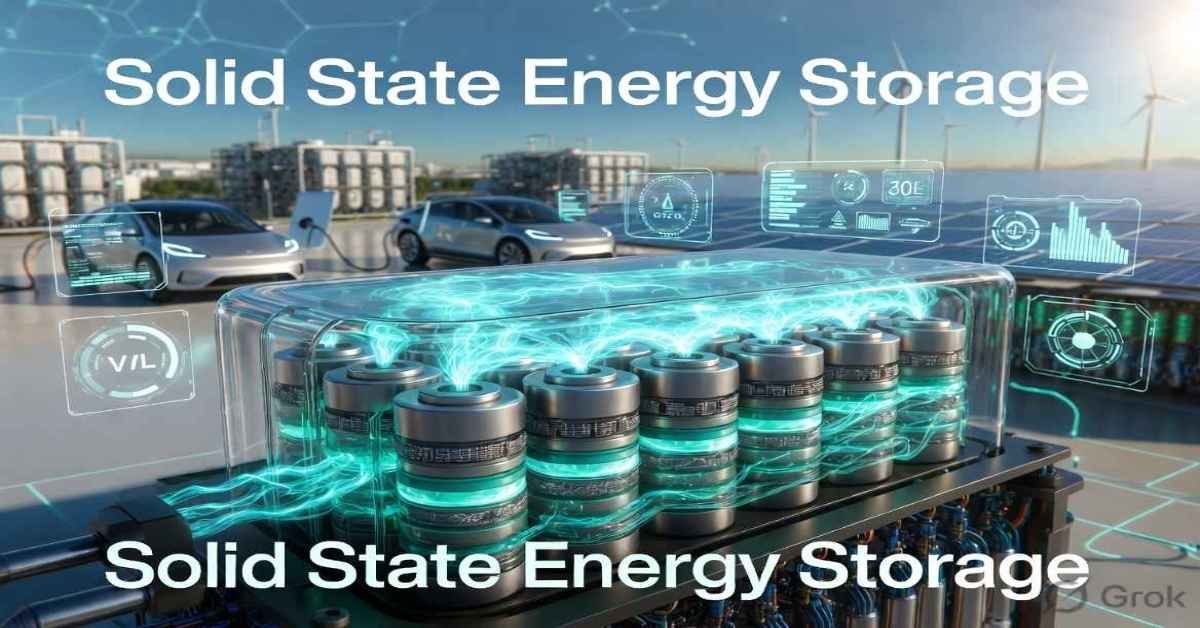
Solid State Energy Storage: The more I learned about battery technology, the more I realized that the batteries powering our phones, laptops, electric vehicles, and backup systems are constantly evolving. One of the most exciting developments I came across was solid state energy storage.
At first, it sounded like another tech buzzword. But after reading research reports, following battery manufacturers, and comparing different energy storage technologies, I understood why so many experts believe solid-state batteries could play a major role in the future of energy storage.
If you’re curious about what solid state energy storage is, how it works, and whether it could replace today’s lithium-ion batteries, this guide explains everything in simple language.
What Is Solid State Energy Storage?
Solid state energy storage refers to battery systems that use a solid electrolyte instead of the liquid electrolyte found in most traditional lithium-ion batteries.
In a conventional battery, ions move through a liquid solution between the positive and negative electrodes. In a solid-state battery, that liquid is replaced by a solid material.
This might sound like a small design change, but it affects almost every aspect of battery performance, including:
- Safety
- Energy density
- Charging speed
- Battery lifespan
- Operating temperature range
Because of these advantages, many researchers and manufacturers see solid-state batteries as a promising next-generation energy storage solution.
Why Current Batteries Have Limitations
Most modern devices rely on lithium-ion batteries.
They have improved significantly over the years, but they still have some well-known challenges:
Heat Generation
Lithium-ion batteries can become hot during charging and discharging.
Fire Risk
Although rare, damaged batteries can catch fire due to thermal runaway.
Limited Energy Density
Manufacturers are always trying to fit more energy into smaller spaces.
Battery Degradation
Repeated charging cycles gradually reduce battery capacity.
These limitations encourage researchers to explore alternatives, leading to increased interest in solid-state technology.
How Solid State Batteries Work
The basic principle remains the same.
Energy is stored chemically and released as electricity when needed.
The major difference is the electrolyte.
Instead of a liquid electrolyte, solid-state batteries use materials such as:
- Ceramic electrolytes
- Sulfide-based electrolytes
- Polymer electrolytes
- Glass-based electrolytes
When the battery charges or discharges, lithium ions move through the solid material between electrodes.
This design can improve stability and reduce safety concerns associated with flammable liquids.
Benefits of Solid State Energy Storage
1. Improved Safety
One of the biggest advantages is safety.
Traditional battery electrolytes can be flammable under certain conditions.
Solid electrolytes are generally much more resistant to leakage and combustion.
For electric vehicles and large energy storage systems, this could be a major improvement.
2. Higher Energy Density
Energy density refers to how much energy a battery can store relative to its size and weight.
Solid-state batteries have the potential to store significantly more energy.
For consumers, this could mean:
- Phones lasting longer
- Laptops needing fewer charges
- Electric vehicles traveling farther
3. Faster Charging Potential
Researchers are working on designs that could support much faster charging times.
Imagine charging an electric vehicle in minutes rather than hours.
While commercial deployment is still developing, this remains one of the most promising benefits.
4. Longer Battery Life
A well-designed solid-state battery may experience less degradation over time.
This could reduce replacement costs and improve overall value.
5. Better Temperature Performance
Many conventional batteries struggle in extremely hot or cold conditions.
Certain solid-state technologies may perform more reliably across wider temperature ranges.
Real-World Applications
Electric Vehicles
Automotive companies are investing heavily in solid-state research.
Potential advantages include:
- Longer driving range
- Faster charging
- Improved safety
- Reduced battery weight
For EV owners, these improvements could solve several common concerns.
Renewable Energy Storage
Solar and wind energy production varies throughout the day.
Energy storage systems help balance supply and demand.
Solid-state batteries could provide:
- Longer service life
- Improved reliability
- Enhanced safety for large installations
Consumer Electronics
Manufacturers constantly look for ways to improve battery life.
Solid-state technology could eventually power:
- Smartphones
- Tablets
- Smartwatches
- Wireless earbuds
- Laptops
Medical Devices
Reliability and safety are critical in healthcare equipment.
Solid-state batteries may offer advantages in devices where battery failure is unacceptable.
Challenges Slowing Adoption
Despite the excitement, solid-state batteries are not yet everywhere.
Several obstacles remain.
Manufacturing Costs
Producing solid-state batteries at scale remains expensive.
Many processes are still being refined.
Production Complexity
Building batteries with solid electrolytes requires advanced manufacturing techniques.
Scaling production from laboratories to factories takes time.
Material Challenges
Researchers continue to work on improving conductivity and durability.
Finding materials that perform well over thousands of charge cycles is not easy.
Supply Chain Development
The battery industry has spent decades building lithium-ion manufacturing infrastructure.
Solid-state technology requires new supply chains and production methods.
Common Misunderstandings
“Solid-State Batteries Already Replace Lithium-Ion”
Not yet.
Most commercial devices still rely on lithium-ion technology.
Solid-state batteries are advancing but remain in early commercialization stages.
“They Never Degrade”
All batteries experience wear over time.
Solid-state batteries may reduce degradation, but they are not immune to aging.
“They Are Completely Risk-Free”
No battery technology is completely without risk.
Solid-state designs can improve safety, but proper engineering remains essential.
What Consumers Should Expect
People often ask when they will be able to buy products powered entirely by solid-state batteries.
The answer depends on the industry.
Some specialized applications may adopt the technology sooner.
Mass-market products such as electric vehicles and consumer electronics are expected to see gradual adoption as manufacturing scales and costs decrease.
Rather than a sudden replacement of lithium-ion batteries, the transition will likely happen step by step.
Practical Advice Before Investing
If you’re considering investing in companies or products related to energy storage, keep these points in mind:
- Focus on companies with proven research programs.
- Avoid believing unrealistic marketing claims.
- Track manufacturing progress, not just laboratory results.
- Compare commercial readiness rather than theoretical performance.
- Understand that large-scale adoption may take years.
Many promising technologies perform well in research settings but face challenges when produced at industrial scale.
Common Mistakes People Make
Assuming New Means Better
New technologies can offer advantages, but they also come with challenges.
Ignoring Cost Factors
Even a superior battery must be affordable to succeed commercially.
Following Hype Instead of Data
Battery technology often attracts headlines.
Always look for measurable performance results and independent testing.
Expecting Immediate Availability
Technology development takes time.
Patience is often necessary when evaluating emerging innovations.
The Future of Solid State Energy Storage
From everything I’ve observed, solid-state batteries represent one of the most promising developments in energy storage.
The combination of improved safety, higher energy density, and potentially faster charging makes the technology attractive for electric vehicles, renewable energy systems, and portable electronics.
The biggest question is not whether solid-state batteries can work. Researchers have already demonstrated that they can.
The real challenge is producing them at scale, at a competitive cost, and with consistent long-term performance.
Over the next decade, solid-state energy storage will likely move from research labs into more commercial products. As manufacturing improves and costs decline, consumers may eventually benefit from batteries that last longer, charge faster, and operate more safely than many of today’s solutions.
For anyone interested in the future of clean energy, electric vehicles, or advanced technology, solid-state energy storage is definitely worth watching.

One thought on “Solid State Energy Storage: What I Learned After Following Battery Technology for Years”